ai-agents · data-ingestion · ai-agent-output · agent-data-pipeline · human-in-the-loop · social-media-apis · rag
AI Agents: Ingestion vs. Output - How Agents Read From and Write To Social Media and Email
Verified API limits and prices for X, Reddit, Instagram, YouTube, TikTok, LinkedIn and Gmail — and why reading data now costs more than writing it.
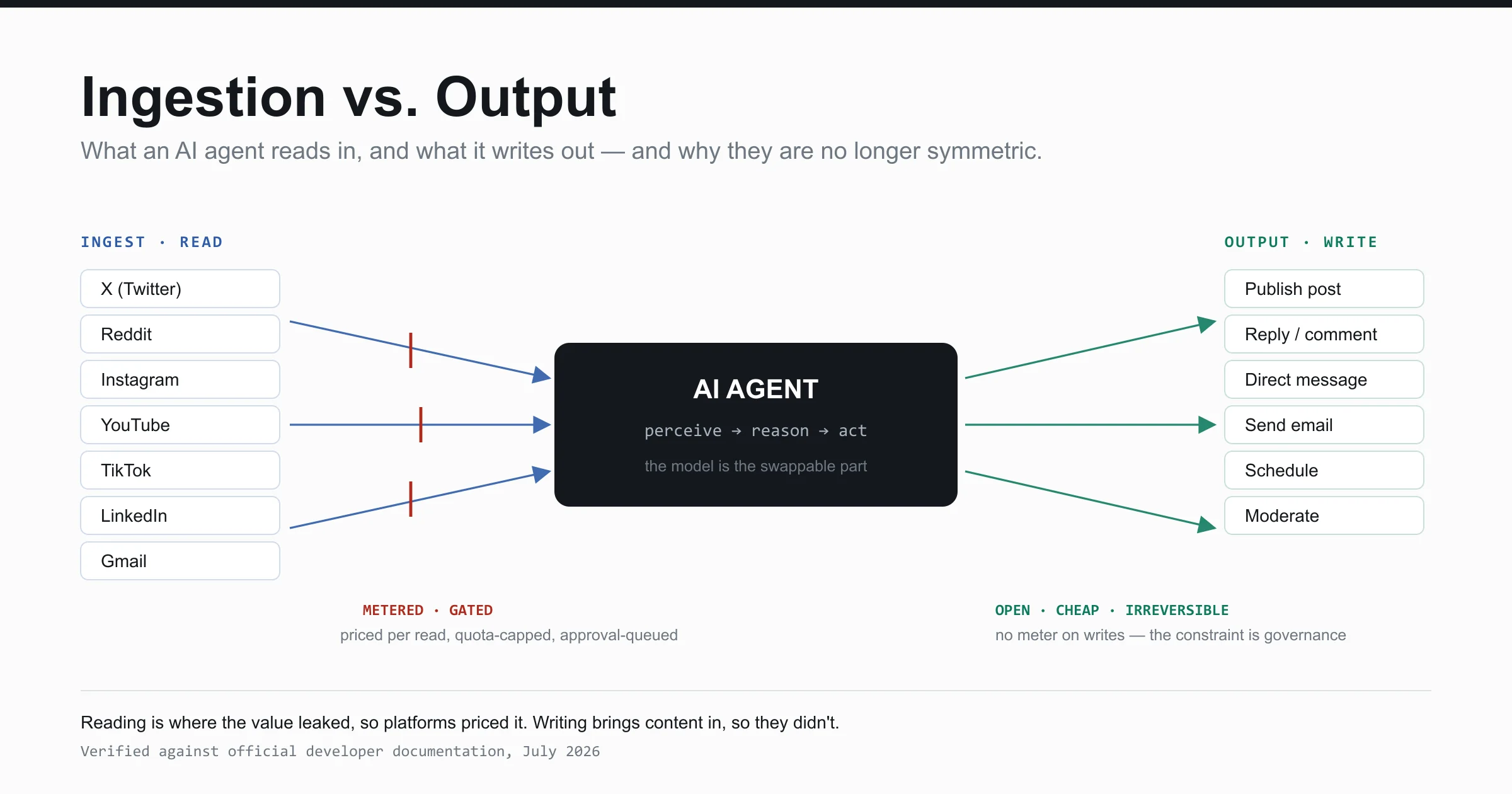
Ingestion is everything an AI agent reads in. Output is everything it writes out. Ingestion covers the posts, mentions, comments, DMs and emails an agent pulls through APIs, webhooks, scrapers and RAG pipelines. Output covers the posts, replies, DMs and emails it pushes back out through API write endpoints, tool calls and schedulers. Same agent, same loop, but two very different engineering problems with two very different risk profiles.
Most explainers treat these as one topic called "data." They aren't. In 2026 the two halves have diverged sharply: ingestion has become the constrained, expensive half because every major platform has enclosed and metered its data, while output stays technically trivial and operationally dangerous because an agent with write access can damage a brand in one API call.
This guide covers the conceptual framework, the pipeline architecture for each side, and a platform-by-platform read/write matrix for X, Reddit, Instagram, Facebook Pages, YouTube, TikTok, LinkedIn and Gmail with limits and prices verified against official developer documentation in July 2026.
Ingestion vs. output at a glance
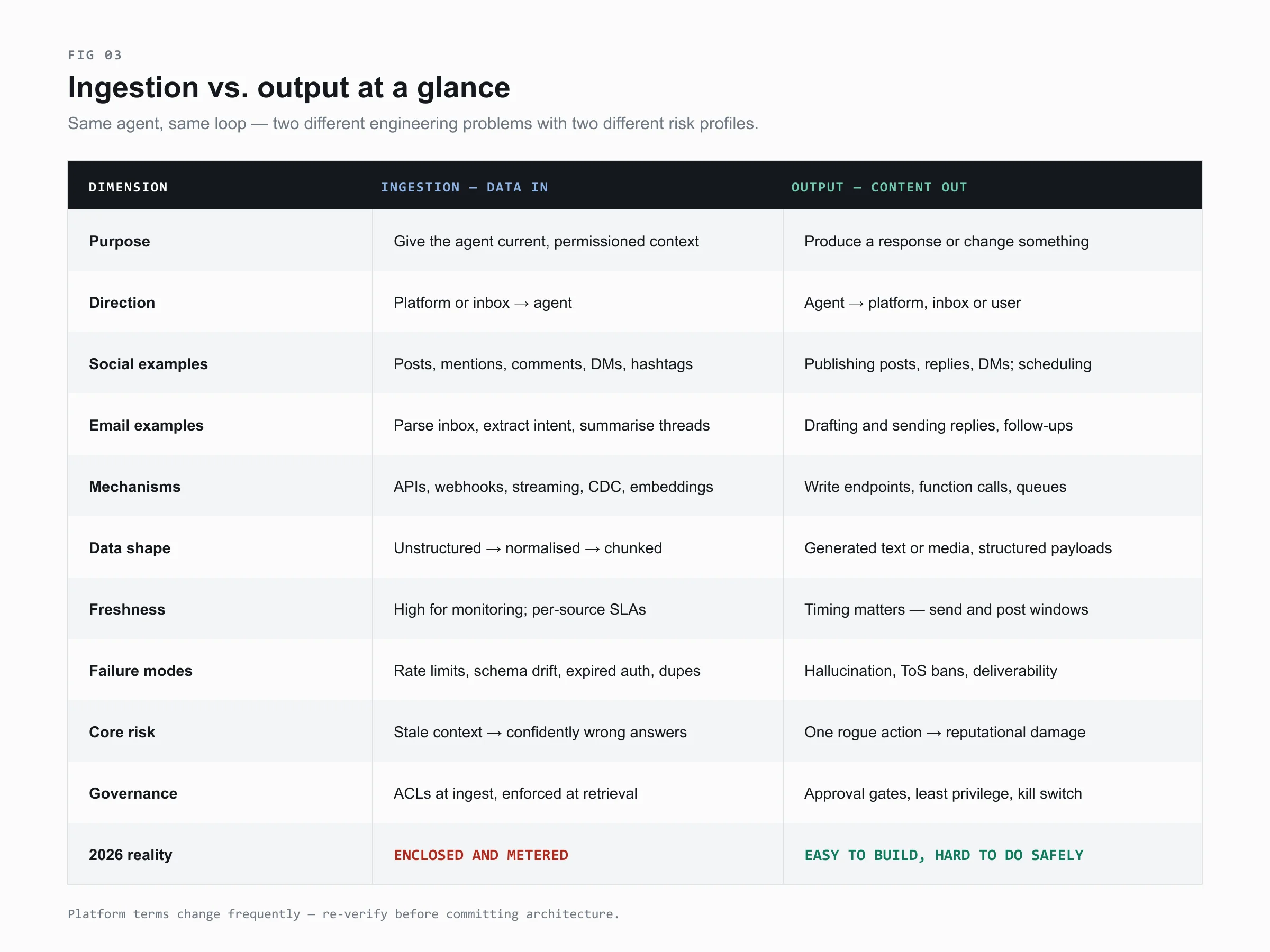
- Purpose — Ingestion: give the agent current, relevant, permissioned context. Output: produce a response or change something in the world.
- Direction — Ingestion: platform or inbox to agent. Output: agent to platform, inbox or user.
- Social examples — Ingestion: reading posts, mentions, comments, DMs, hashtags; social listening; trend detection. Output: publishing posts, replies, DMs; scheduling content.
- Email examples — Ingestion: parsing the inbox, extracting intent and entities, summarising threads. Output: drafting and sending replies, follow-ups, outreach sequences.
- Mechanisms — Ingestion: APIs, webhooks, streaming, batch sync, CDC, scrapers, chunking, embeddings. Output: API write endpoints, function calls, schedulers, queues.
- Data shape — Ingestion: mostly unstructured, normalised then chunked. Output: generated text or media, structured API payloads.
- Freshness — Ingestion: high for monitoring; set per-source SLAs. Output: timing matters (send and post windows).
- Main failure modes — Ingestion: rate limits, schema drift, expired auth, permission leakage, duplication, token cost. Output: hallucination, off-brand content, ToS bans, deliverability, approval bottlenecks.
- Core risk — Ingestion: stale, incomplete or unauthorised context produces confidently wrong answers. Output: one rogue action creates reputational or legal damage.
- Governance controls — Ingestion: ACLs captured at ingest and enforced at retrieval, freshness SLAs, PII filtering, audit trails. Output: human approval gates, least privilege, rate caps, kill switch.
- 2026 reality — Ingestion: enclosed and metered. Output: easy to build, hard to do safely.
The loop underneath: perceive, reason, act
Every agent runs the same cycle. It perceives its environment, reasons over what it perceived using a model, then acts through tools, then observes the result and goes round again. AWS and IBM both describe agents this way in their architecture documentation, and it's the cleanest mental model for the ingestion/output split.
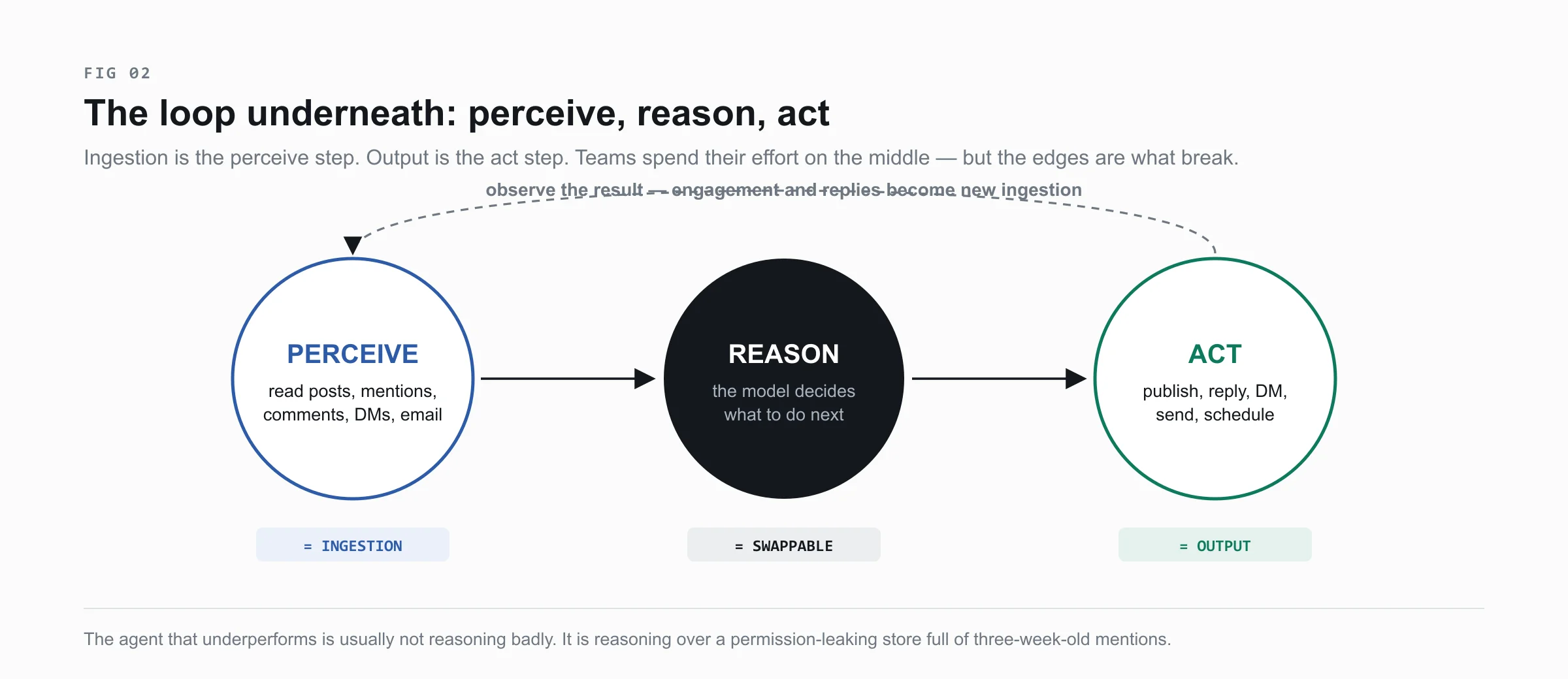
Ingestion is the perceive step. Output is the act step. The reasoning core sits between them and is largely interchangeable — you can swap models. What you cannot swap easily is the quality of what flows in and the safety of what flows out.
This matters because teams routinely spend their effort on the middle. Prompt engineering, model selection, evaluation harnesses. Then the agent underperforms and everyone blames the model, when the actual problem is that it was reasoning over a permission-leaking vector store full of three-week-old mentions.
Gartner has been blunt about which half breaks first. In February 2025, analyst Roxane Edjlali's team projected that through 2026 organisations will abandon 60% of AI projects unsupported by AI-ready data, based on a Q3 2024 survey of 248 data-management leaders. In June 2025, Gartner separately predicted over 40% of agentic AI projects will be cancelled by end of 2027 on escalating costs, unclear business value or inadequate risk controls. Both failure modes live at the edges of the loop, not in the middle.
The vocabulary you actually need
Data ingestion — discovering, collecting, normalising and moving data from source systems into stores an agent can consume.
Output or action — anything the agent emits into the world: a published post, a sent email, a tool call that changes external state.
Structured vs. unstructured — structured data fits rows and columns. Social posts and emails don't; they're unstructured text carrying structured metadata. Databricks, IBM and MongoDB all put unstructured data at 80–90% of enterprise data, which is why agent ingestion leans on parsing, chunking and embeddings rather than plain ETL.
Batch vs. streaming — batch pulls on a schedule and is cheap but stale. Streaming moves events as they occur, fresher but more complex. Micro-batch splits the difference.
Webhook — the platform sends an HTTP POST to your endpoint when something happens. Push, not poll. Always cheaper than polling when available.
RAG (retrieval-augmented generation) — grounding model output in retrieved documents. Ingestion is the offline half (load, chunk, embed, store). Retrieval and generation is the runtime half.
Embeddings and vector databases — embeddings turn text into numeric vectors capturing meaning. Vector stores (Pinecone, Milvus, Weaviate, FAISS) index them for similarity search.
ACL (access control list) — permission metadata that must be captured at ingestion time and enforced at retrieval time, so the agent physically cannot surface something the requesting user shouldn't see.
MCP (Model Context Protocol) — Anthropic's open standard for connecting agents to tools and data sources without bespoke integrations for each one.
HITL (human in the loop) — the agent does the work but cannot commit irreversible actions without a person approving.
How ingestion works for AI agents
The five-stage pipeline
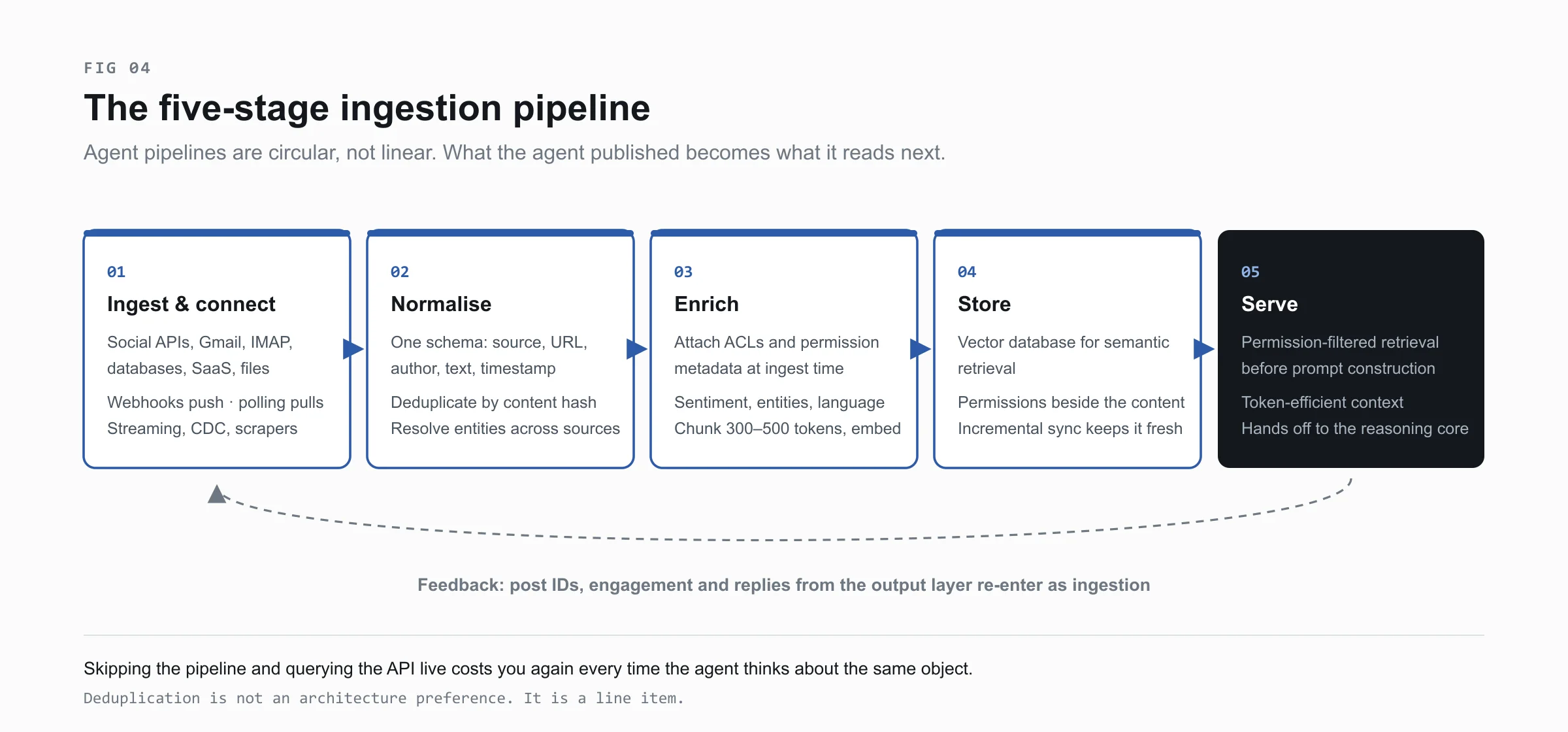
1. Ingest and connect. Sources are social APIs, email (Gmail API or IMAP), databases, SaaS tools, event streams and files. Mechanisms are connectors, webhooks for push, polling for pull, streaming through Kafka or Kinesis or Pub/Sub, change data capture for databases, and scrapers where the platform permits it.
2. Normalise. Map every record from every source onto one schema: source, URL, author, text, timestamp, thread ID. Deduplicate with content hashing before anything else touches the data. Resolve entities so the same person on X and in your CRM is one person.
3. Enrich and transform. Attach permission metadata and ACLs. Add sentiment, entities, language. Chunk the text (300–500 tokens is a common starting range) and embed it.
4. Store. Vector database for semantic retrieval, permission metadata stored alongside the content rather than in a separate system, incremental sync or CDC to keep it fresh without re-ingesting the world.
5. Serve. At runtime, retrieve permission-filtered and token-efficient context for the reasoning core. Then feed outcomes back in — engagement on the posts you published becomes new ingestion. Agent pipelines are circular, not linear.
Why you don't just query the API live
The tempting shortcut is to skip the pipeline entirely and have the agent call the platform API at request time. Airbyte's position on this is worth quoting: it can work in small demos, but it does not scale well, because runtime queries hit rate limits, inconsistent permissions, missing historical state and repeated parsing work.
There's a sharper version of this argument in 2026. When X charges $0.005 per post read, live querying means you pay again every time the agent thinks about the same tweet. A governed ingestion layer with deduplication is not just an architecture preference; it's a line item.
Agent ingestion is not analytics ingestion
Traditional pipelines fed dashboards, so a nightly batch was fine and everyone reading the warehouse had the same permissions. Agent pipelines feed a live decision-maker acting on behalf of a specific user. Three things change:
- Cadence shifts from one scheduled batch to per-source freshness SLAs. A crisis-monitoring source needs seconds. A competitor's blog needs a day.
- Permissions shift from uniform warehouse access to user-level ACLs carried all the way into retrieval, filtered before prompt construction rather than after.
- Recovery shifts from "re-run the batch job" to "replay with idempotency," because the agent may already have acted on what it read.
Add token efficiency as a fourth. Every unnecessary chunk you retrieve is money and a dilution of the model's attention.
How output works for AI agents
The output layer is a smaller piece of engineering. It manages per-platform authentication tokens, applies rate limiting, formats content to each platform's constraints, queues items for delivery windows, and captures the response — post IDs, error codes, engagement — which then flows back into ingestion.
The highest-value pattern is fan-out from one input: a single long-form piece becomes a LinkedIn post, an X thread, an Instagram caption and a newsletter section, each rewritten for its medium rather than copy-pasted.
Three levels of autonomy
- AI-assisted. The human drives every decision; the agent drafts and suggests.
- Autonomous with guardrails. The agent drives; the human approves anything public or irreversible.
- Fully autonomous. End to end, no human in the path.
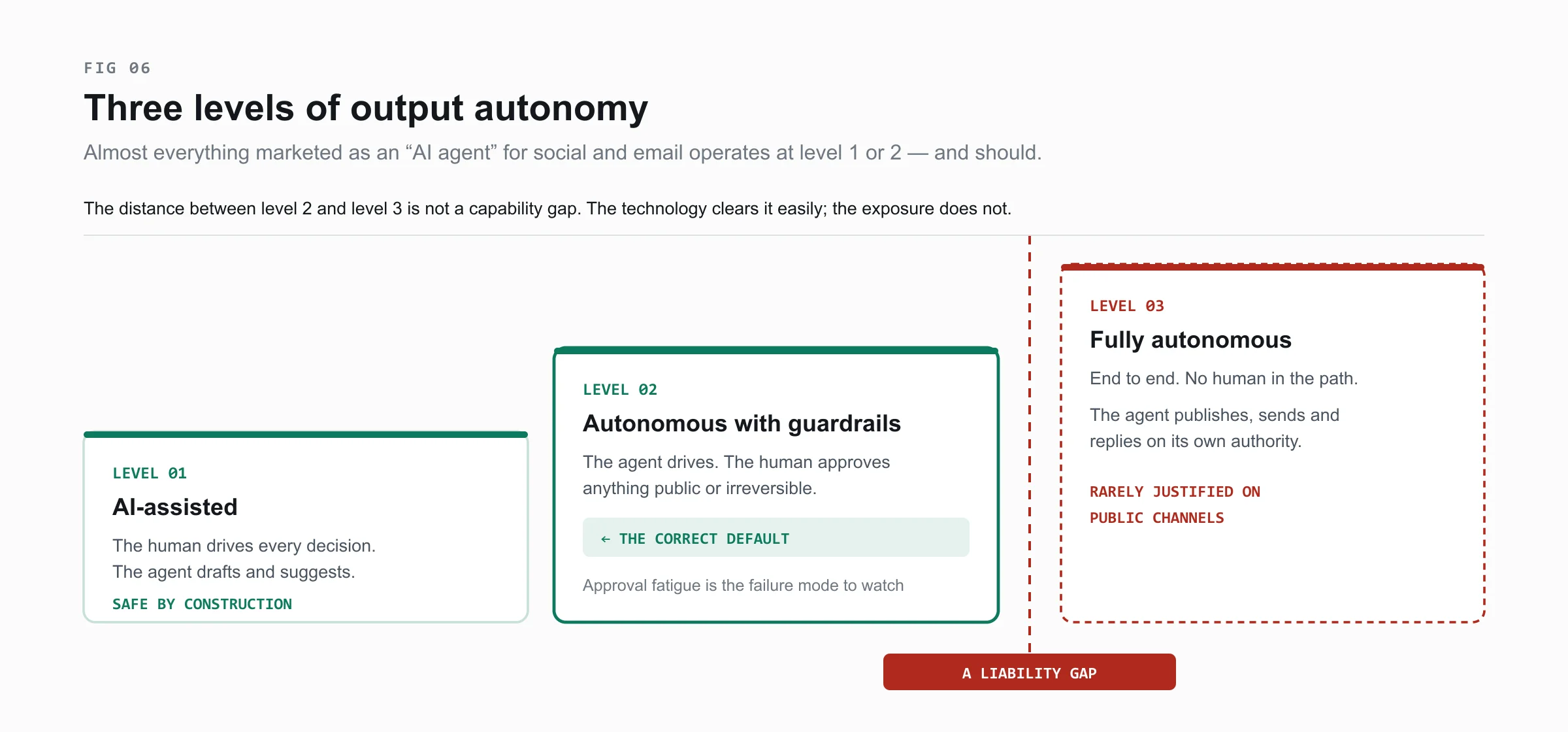
Almost everything marketed as an "AI agent" for social and email operates at level 1 or 2, and that is the correct place for it to operate. The gap between levels 2 and 3 is not a capability gap. It's a liability gap.
Grade actions by consequence, not by type
The useful governance question isn't "is this an agent action?" but "how bad is this if it's wrong, and can I undo it?"
- Reversible and private (drafting, labelling, internal summaries): let it run.
- Reversible but visible (scheduling a post for later, applying a CRM tag): let it run with logging and a review queue.
- Irreversible or public (publishing, sending, replying to a customer, DMing a prospect): require approval.
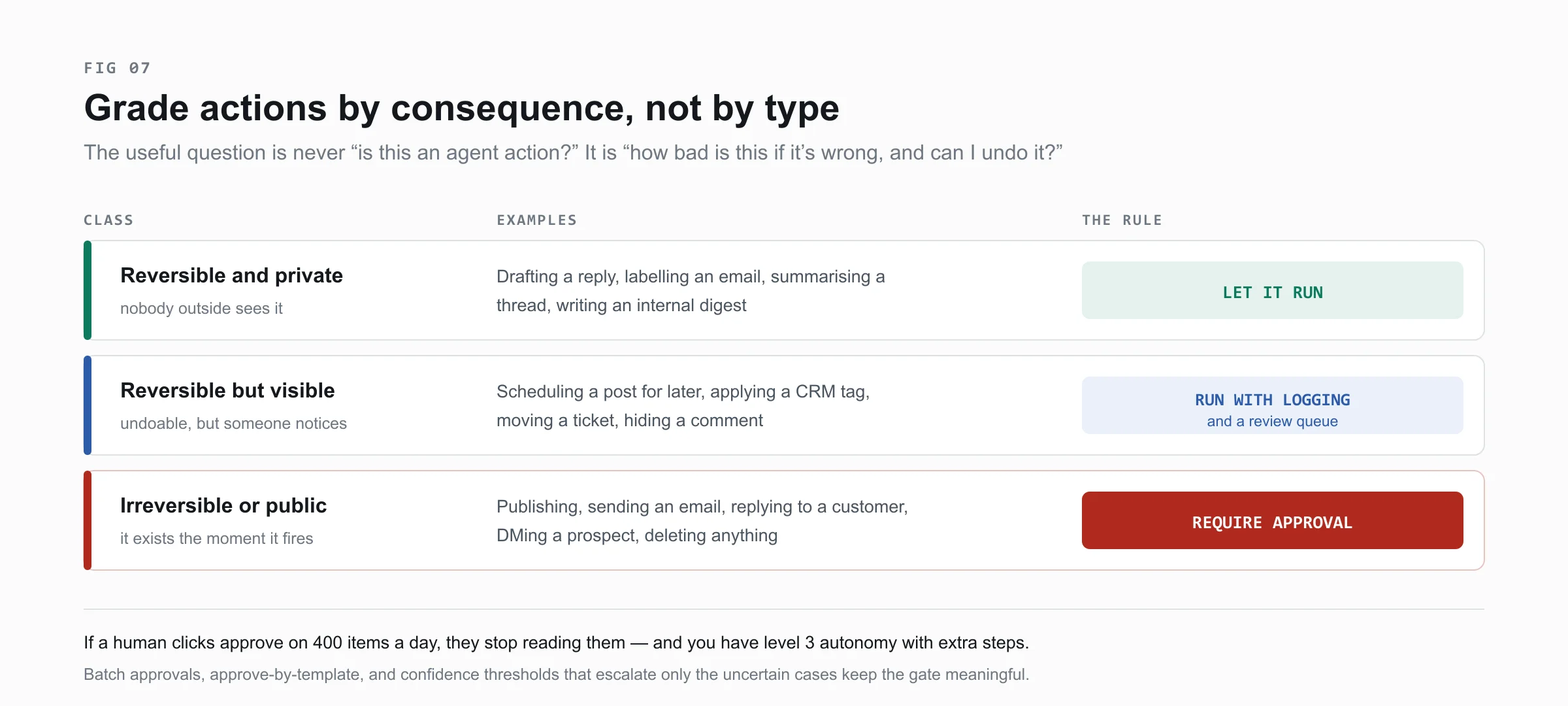
Approval fatigue is the real threat to this model. If a human has to click approve on 400 items a day, they stop reading them, and you have level 3 autonomy with extra steps and a false sense of safety. Batch approvals, approve-by-template, and confidence thresholds that only escalate the uncertain cases are what keep the gate meaningful.
Platform-by-platform: what you can read, what you can write
This is where general guides stop and where the actual project decisions get made. Figures below were checked against official developer documentation in July 2026. Platform terms change frequently; re-verify before you commit architecture to them.
X (Twitter) API v2
The big change: in February 2026 X made pay-per-usage the default, closing the old flat Basic ($200) and Pro ($5,000) subscription tiers to new signups. Existing subscribers keep their plans. New developers now load credits in the Developer Console and are billed per resource.
Per X's official pricing documentation:
- Post read — $0.005 per resource
- User read — $0.010 per resource
- DM event read — $0.010 per resource
- Following/followers read — $0.010 per resource
- Owned reads (your own posts, mentions, bookmarks, followers, lists) — $0.001 per resource
- Post create — $0.015 per request
- Post create containing a URL — $0.200 per request
- DM interaction create — $0.015 per request
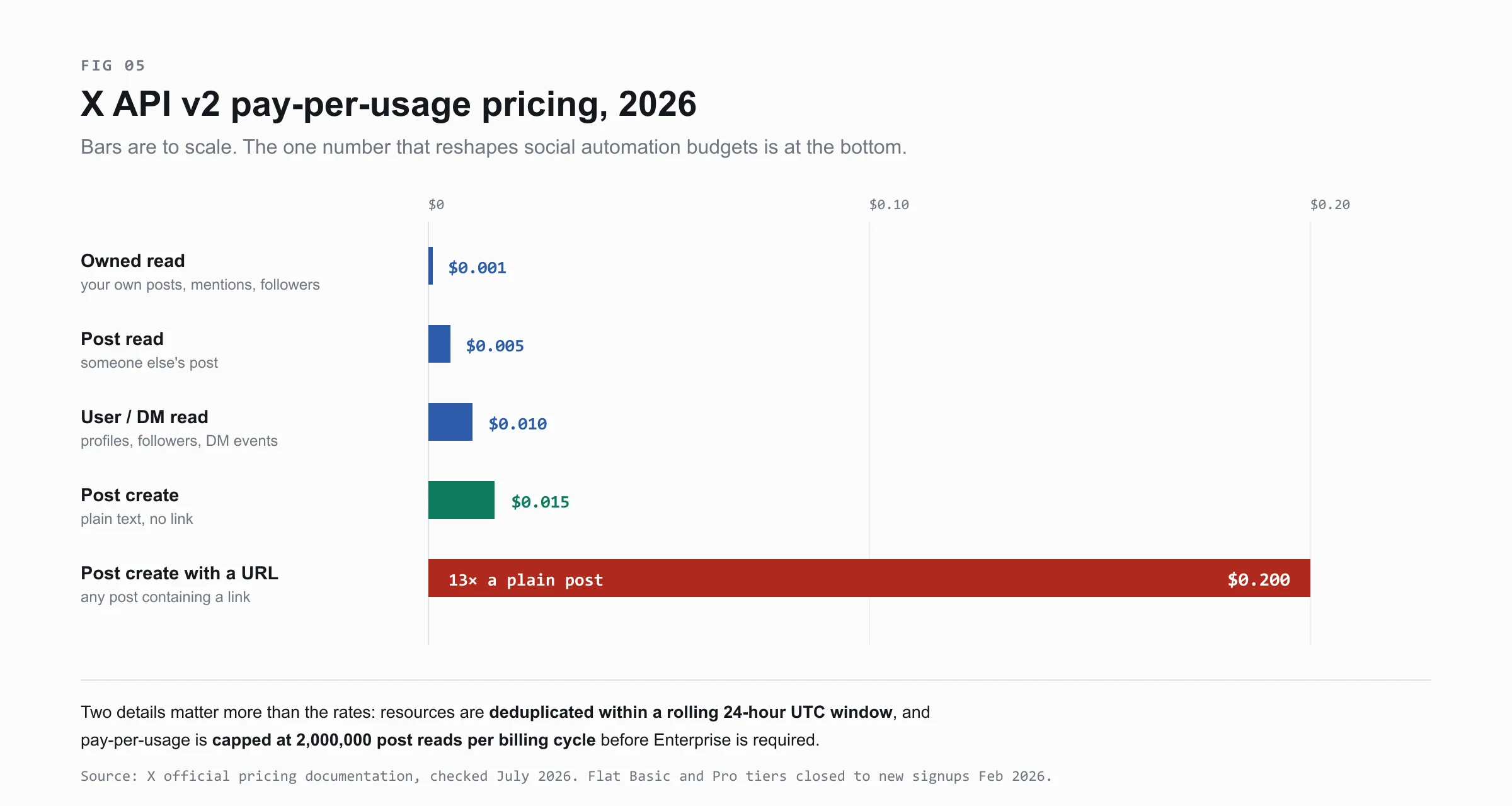
Two details matter more than the headline rates. First, resources are deduplicated within a 24-hour UTC window, so re-requesting the same post the same day doesn't re-charge you. X calls this a soft guarantee, not an absolute one, but it rewards a caching ingestion layer directly. Second, pay-per-usage plans are capped at 2 million post reads per billing cycle, and above that you need Enterprise.
The $0.20 charge on posts containing a URL is the single most under-appreciated number in social automation right now. It's a 13× premium over a plain post. An agent auto-publishing link posts at any volume has a bill that looks nothing like the same agent publishing text.
Practical read: X is now cheap for agents that work with their own account's data and expensive for agents that monitor other people's. That's a deliberate design choice, and it reshapes which use cases are viable.
Reddit Data API
Ingestion. The free tier is 100 queries per minute per OAuth client, 10 QPM unauthenticated, averaged over a rolling ten-minute window so short bursts are tolerated. It is explicitly non-commercial. Structural limits bite harder than the rate limit: listing endpoints cap at roughly 1,000 items, there's no date-range search and no comment search, and Pushshift's historical archive is gone.
The 2025 change most guides missed: Reddit's Responsible Builder Policy, introduced in November 2025, extended pre-approval to all developers, not just commercial ones. Self-service registration is effectively closed; new OAuth access goes through a manual review queue that community reports put at multiple weeks with a meaningful rejection rate.
Commercial access is negotiated, not self-serve. The widely cited baseline is around $0.24 per 1,000 API calls, with reported enterprise minimums in the region of $12,000. Reddit does not publish a public rate card, so treat these as directional.
Output. Submissions, comments and moderation actions all work through OAuth, with PRAW the mature Python wrapper. The same 100 QPM ceiling applies, plus account age and karma rules that will silently throttle a new bot account.
Instagram (Meta Graph API)
Ingestion. Hashtag search is the hard constraint: a Business or Creator account can query a maximum of 30 unique hashtags in a rolling 7-day period, per Meta's documentation. Re-querying the same tag inside the window doesn't count again, which makes caching essential. There's also a ceiling of roughly 200 requests per hour per user token. Mentions and tagged media are available through /tags and /mentioned_media. Emoji hashtags and Story hashtags are unsupported, and there is no retrospective mention search — if you weren't watching, you missed it.
Hashtag search additionally requires both the instagram_basic permission and the Instagram Public Content Access feature, granted through Meta App Review.
Real-time. Webhooks deliver notifications for comments and story insights, signed with HMAC-SHA256. This is the correct way to build moderation or auto-reply; polling for comments burns your hourly quota for nothing.
Output. Publish images, reels, carousels of up to 10 items, and stories — all via publicly accessible URLs rather than direct file upload, which means you need somewhere to host media first. Comment creation, replies, hiding and deletion work with instagram_manage_comments. DMs work with instagram_manage_messages under the 24-hour customer-initiated window, extendable to 7 days with the Human Agent tag.
Facebook Pages
The most balanced platform of the set. Meta's Pages API supports creating, publishing, updating and deleting Page posts and comments, plus reading Page Insights. Webhooks on the page feed object deliver real-time notifications with an item type (post, comment, photo, video) and a verb (add, edited, remove), which is enough to build a full listening and response loop without polling.
Requires pages_manage_metadata and pages_read_engagement, and Meta's App Review.
YouTube Data API v3
This changed in 2026 and most guides are wrong about it. The old model was a single pool of 10,000 quota units per project per day, with search.list costing 100 units and video uploads costing about 1,600.
Per Google's current documentation, projects now get a default allocation of 100 search.list calls, 100 videos.insert calls, and 10,000 units per day combined for all other endpoints. Search and upload were split out of the shared pool into their own dedicated daily buckets. Uploads no longer compete with reads for budget, and the practical search ceiling is now explicit rather than an emergent consequence of unit math.
Most list operations still cost 1 unit, so comment and video metadata reads are cheap. There is no webhook or streaming surface; you poll. Quota resets at midnight Pacific. There is no self-service way to buy more — you file the Quota Extension Request form and wait, and requests that look like bulk harvesting are routinely declined.
Design implication: replace search.list with playlistItems.list wherever you can. Fetching a channel's uploads playlist costs 1 unit and gets you the same videos that a 100-unit search would.
TikTok
Three separate APIs, and the one you want is the one you can't have.
- Research API — the only surface offering keyword, hashtag and comment search. Restricted to qualifying academic and non-profit institutions in the US, EEA, UK, Switzerland and Brazil, capped around 1,000 requests per day, roughly four weeks to approve. TikTok narrowed eligibility further between 2025 and mid-2026, and using research credentials for commercial work now risks losing access outright.
- Display API — re-displays a creator's own authorised content. 600 requests per minute per endpoint. A distribution surface, not a data surface.
- Content Posting API — publishes on a user's behalf at 6 requests per minute per user token. Until your app passes TikTok's audit, everything it publishes is forced to private visibility. A clean audit runs one to two weeks.
TikTok charges nothing at the endpoint level for any of these. The cost is calendar time and eligibility. In 2026 TikTok also introduced a Creator Search Insights API returning creator-level data, the first meaningful widening in a while, but it doesn't replace hashtag listening.
Net: commercial TikTok brand monitoring through official APIs is effectively off the table. Teams either license a third-party data provider or go without.
The most restrictive platform, and the one where automation carries genuine account risk.
Output runs through the Community Management API: text, images, video, multi-image posts, link shares, articles and polls, to member profiles (w_member_social) and organisation pages (w_organization_social), with a LinkedIn-Version header on every call. Access is two-tier — a Development Tier with limited call volume on initial approval, and a Standard Tier requiring a further application plus a screencast demonstrating each stated use case. Per Microsoft Learn, Community Management APIs are available only to registered legal organisations for commercial use cases, and approval requires business email verification, legal name, registered address, website and privacy policy.
Organic PDF document carousels are not supported through the API.
On the @mention dispute. Some vendor documentation claims LinkedIn API posts can only contain plain-text mentions. LinkedIn's own documentation contradicts this: the Community Management API explicitly supports @mentioning members using the People Typeahead API, including a typeahead search over an organisation's followers and a vanity-name lookup. Trust the official docs, but test it in your own integration before you promise it to anyone, because vendor confusion this persistent usually has a rendering edge case behind it.
Ingestion is where LinkedIn says no. There is no documented endpoint that searches all public LinkedIn content for mentions of your organisation. You can retrieve posts authored by a member or organisation by author URN, and you can monitor @mentions and comments on your own content through the Social Actions and Notifications APIs. Network-wide listening is not a supported capability.
Scraping to fill the gap runs into User Agreement Section 8.2, which prohibits developing, supporting or using software, scripts, robots or other means to scrape or copy the Services, and separately prohibits using bots or unauthorised automated methods to add or download contacts, send or redirect messages, or create, comment on, like, share or re-share posts. The hiQ litigation established that scraping public data isn't automatically a Computer Fraud and Abuse Act violation, but it left contract claims and account termination entirely intact. For an individual, the practical risk isn't a lawsuit; it's losing the account. LinkedIn reported that automated defences blocked 97.1% of fake accounts before anyone reported them in the first half of 2025.
Email: Gmail, Outlook, IMAP
Email is the platform that got easier while social got harder, and it's the reason email agents are outpacing social agents in production deployment.
Ingestion. The Gmail API provides server push notifications through Cloud Pub/Sub. You call users.watch pointing at a Pub/Sub topic; Gmail publishes an emailAddress and a historyId watermark when something changes; you call users.history.list to fetch what changed since your last watermark. The watch expires after 7 days and must be renewed — Google recommends daily, and forgetting this is the single most common way these integrations silently die. IMAP polling remains the legacy fallback.
Content is parsed from MIME into text and metadata, commonly converted to Markdown, labelled, chunked and indexed for retrieval. Unipile, EmailEngine and InboxParse are the usual middleware if you don't want to own MIME parsing.
Output. users.messages.send and the users.drafts endpoints. The draft-first pattern is standard: the agent writes into the user's real draft folder, the user reviews in their own client, and sending stays a human action. It's the cleanest human-in-the-loop implementation available on any platform because the approval surface already exists and people already live in it.
Watch the unverified-app 100-user cap during development, and remember that email output carries legal obligations social output doesn't — CAN-SPAM, GDPR, and deliverability reputation that an over-eager outreach agent can destroy in a week.
Summary: read vs. write across every major platform
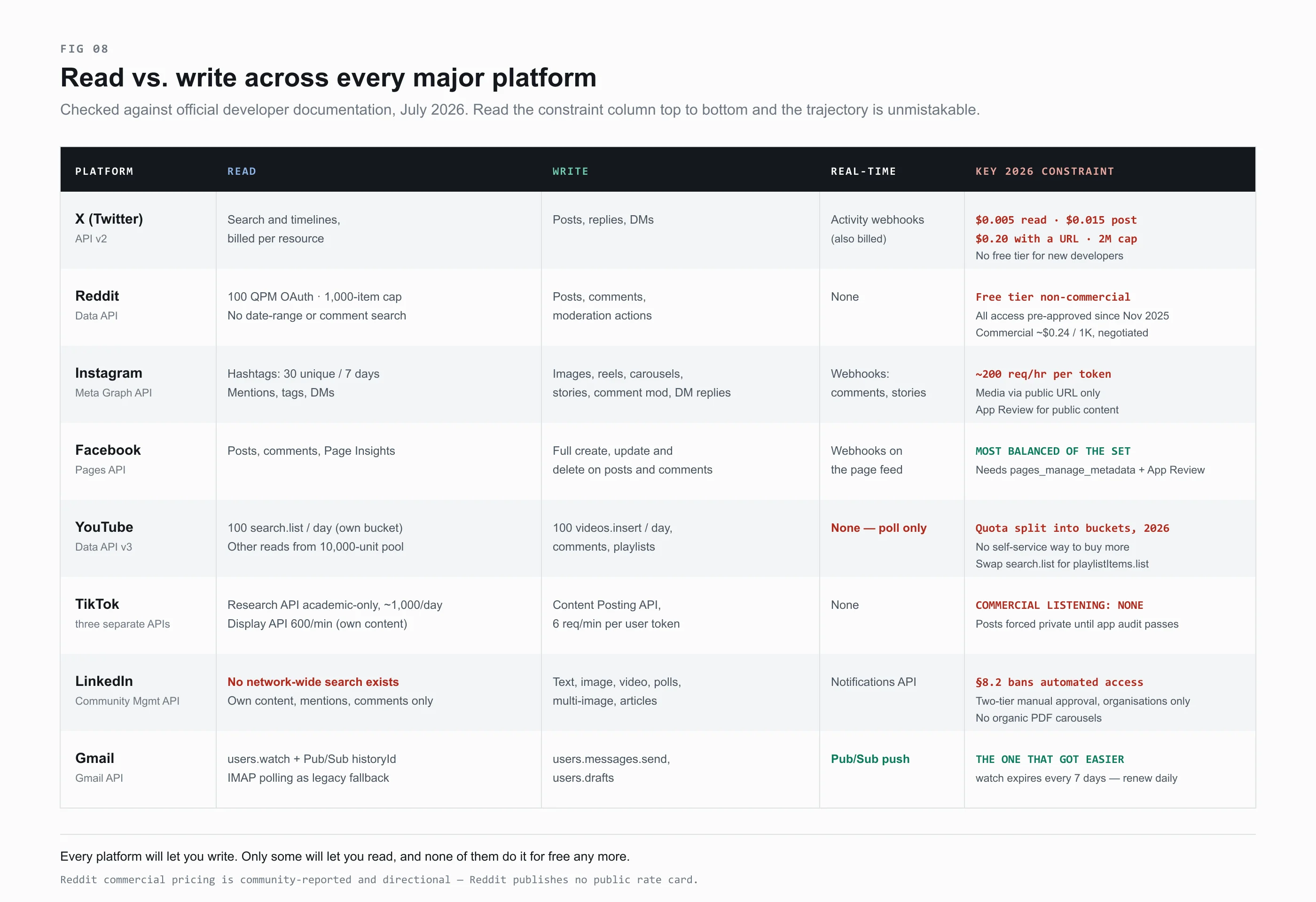
- X API v2 — Read: search and timelines, billed per resource. Write: posts, replies, DMs. Real-time: Activity API webhooks (billed per event). Key 2026 constraint: $0.005/post read, $0.015/post, $0.20 if it has a URL; 2M read cap; no free tier.
- Reddit — Read: 100 QPM OAuth, 1,000-item cap, no date or comment search. Write: posts, comments, mod actions. Real-time: none. Key 2026 constraint: free tier non-commercial; all access pre-approved since Nov 2025; commercial ~$0.24/1K, negotiated.
- Instagram — Read: hashtags (30 unique / 7 days), mentions, tags, DMs. Write: images, reels, carousels, stories, comment mod, DM replies. Real-time: webhooks (comments, story insights). Key 2026 constraint: ~200 req/hr/token; media via public URL only; App Review for public content.
- Facebook Pages — Read: posts, comments, insights. Write: full create/update/delete on posts and comments. Real-time: webhooks on page feed. Key 2026 constraint: needs pages_manage_metadata + App Review.
- YouTube — Read: 100 search.list/day (own bucket), other reads from 10,000-unit pool. Write: 100 videos.insert/day (own bucket), comments, playlists. Real-time: none — poll only. Key 2026 constraint: buckets split in 2026; no self-service quota purchase.
- TikTok — Read: Research API academic-only (~1,000/day); Display API 600/min. Write: Content Posting API, 6/min per user token. Real-time: none. Key 2026 constraint: audit required or posts forced private; commercial listening unavailable.
- LinkedIn — Read: own content, mentions and comments only; no network-wide search. Write: text, image, video, polls, multi-image, articles to profiles and pages. Real-time: Notifications API. Key 2026 constraint: two-tier manual approval, orgs only; §8.2 bans automation; no PDF carousels.
- Gmail — Read: users.watch + Pub/Sub historyId; IMAP fallback. Write: messages.send, drafts. Real-time: Pub/Sub push. Key 2026 constraint: watch expires every 7 days; renew daily.
The 2026 enclosure: why ingestion became the harder half
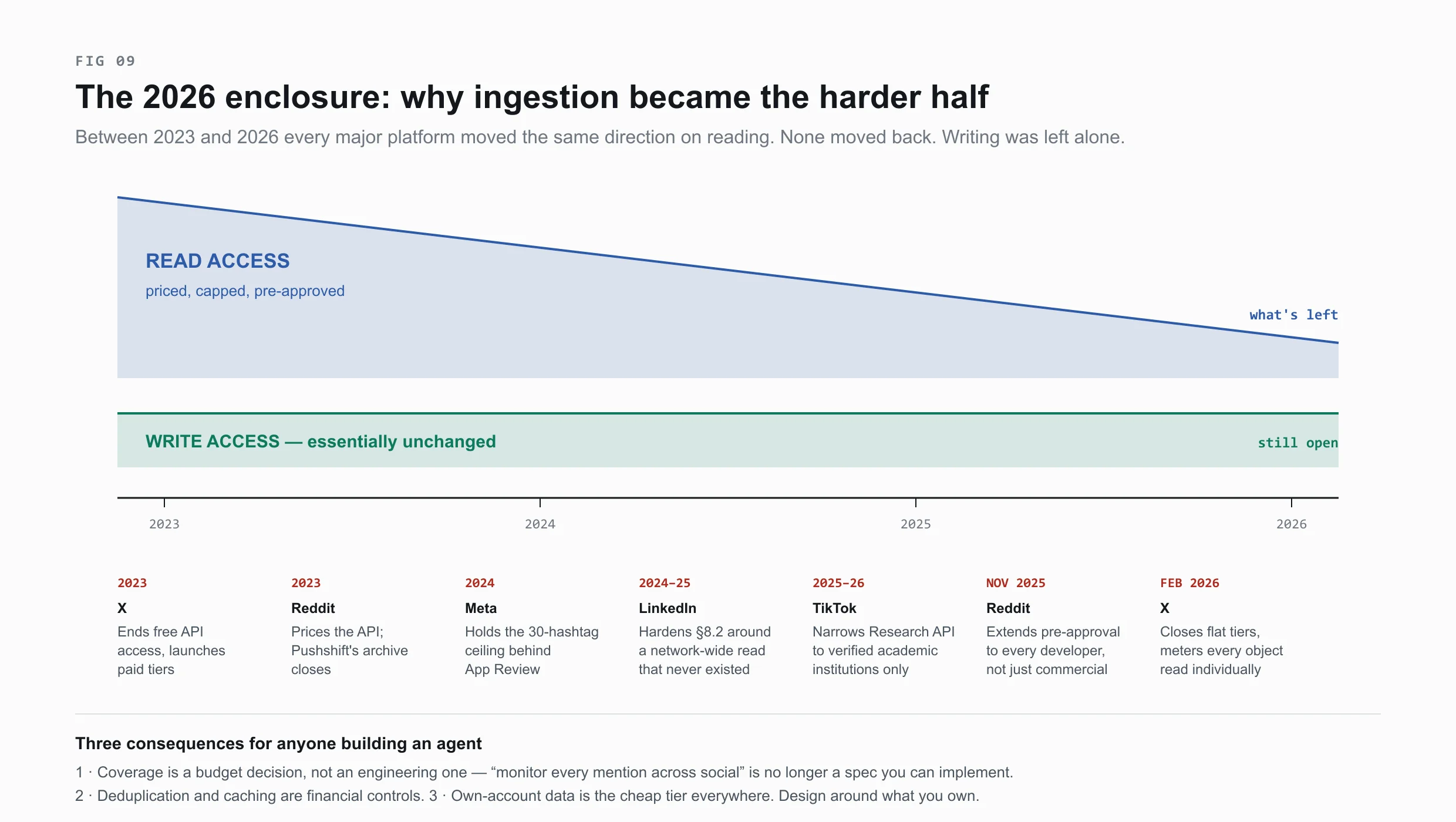
Read the matrix top to bottom and a single trajectory falls out. Between 2023 and 2026 every major platform moved the same direction, and none moved back.
X replaced open access with subscriptions, then replaced subscriptions with a meter that charges per object read. Reddit priced commercial access, then in late 2025 extended pre-approval to everyone including hobbyists. TikTok narrowed research access to verified academic institutions and told commercial users to license data elsewhere. LinkedIn never opened network-wide reading in the first place and hardened its anti-automation terms around it. Meta kept its 30-hashtag ceiling and its App Review gate. Google split YouTube's quota into buckets that make the search ceiling explicit.
The pattern is consistent: reading is being priced and gated, writing largely isn't. X charges $0.015 to publish a post and $0.005 to read one, but you can publish all day and you hit a hard wall at 2 million reads. TikTok will let your app post once audited but won't let a commercial team search hashtags at any price. LinkedIn will let you publish to a company page but not find out who mentioned it.
The reason is obvious once stated. Reading is where the training-data and competitive-intelligence value sits, and platforms watched that value leave for free from 2010 to 2022. Writing brings content onto the platform, which platforms want. They are not symmetric goods, and the pricing now reflects that.
Three consequences for anyone building an agent:
- Coverage is a budget decision, not an engineering one. "Monitor every mention of our brand across social" is no longer a spec you can implement. You choose which platforms, at what freshness, at what cost, and you accept blind spots on the rest.
- Deduplication and caching are financial controls. X's 24-hour dedup window means a careless architecture that re-reads the same posts across multiple agent invocations pays multiple times for nothing. Ingest once, store, retrieve locally.
- Own-account data is the cheap tier everywhere. X prices owned reads at a fifth of standard reads. LinkedIn and TikTok only give you your own content. Design agents around what you own and treat competitive listening as a separate, budgeted programme.
Common failure modes
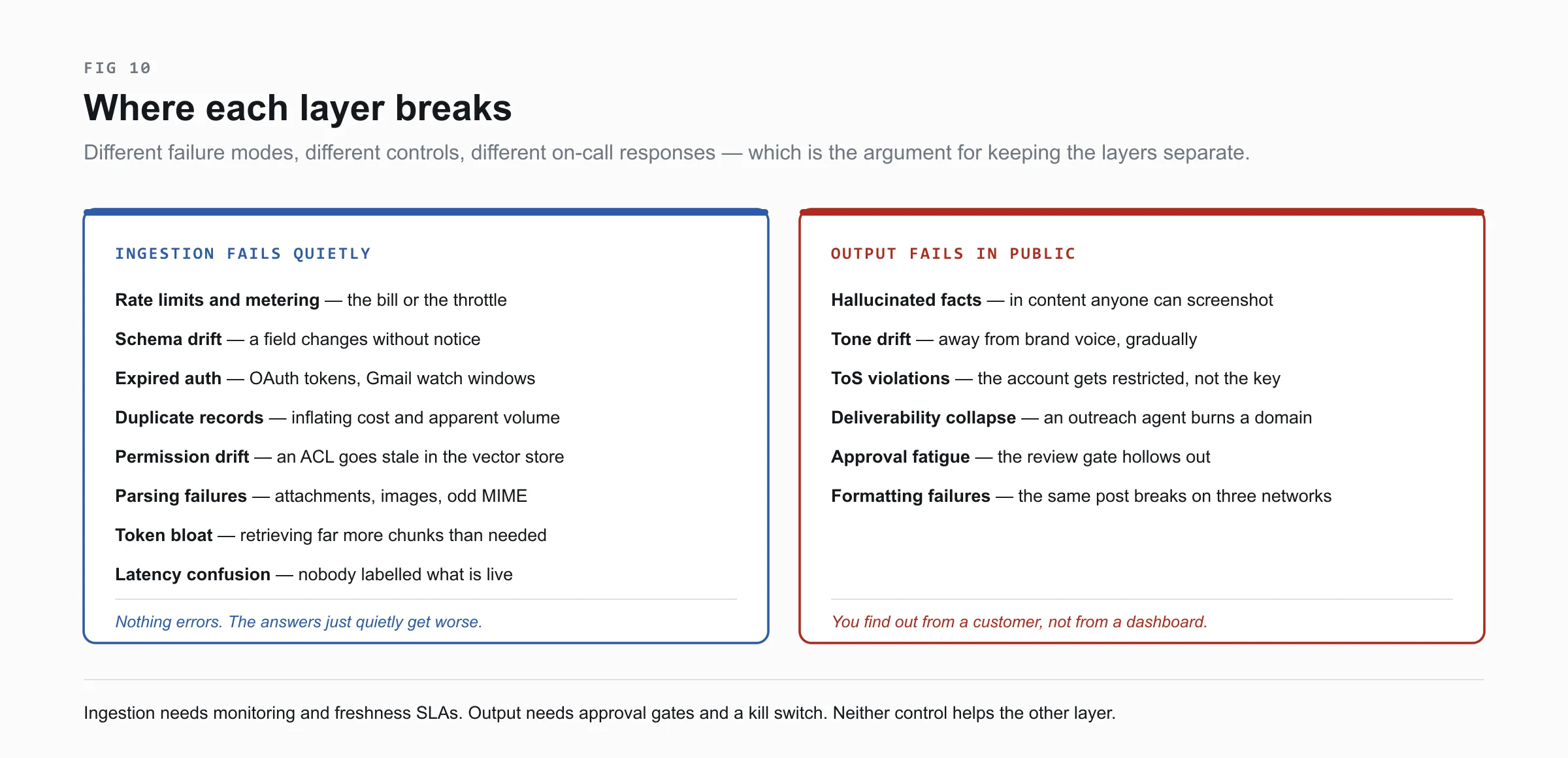
On the ingestion side: rate limits and metering; schema drift when a platform changes a field without notice; OAuth token expiry (and Gmail watch expiry, its own special case); duplicate records inflating both cost and apparent volume; permission drift where an ACL captured at ingest goes stale in the vector store; parsing failures on attachments and images; token bloat from retrieving too many chunks; and latency confusion, where nobody labelled which data is live and which is two days old so the agent treats an old mention as breaking news.
On the output side: hallucinated facts in public content; tone drift away from brand voice; ToS violations that get the account restricted rather than the API key revoked; email deliverability collapse from volume; approval fatigue hollowing out the review gate; and per-platform formatting failures that make the same content look broken on three networks.
Ten practices that hold up
- Keep ingestion and output as separate, independently governed layers. Different failure modes, different controls, different on-call responses.
- Set freshness SLAs per source, not globally. Webhooks where signal decays fast; batch where it doesn't.
- Capture ACLs at ingestion and enforce them at retrieval, filtering before prompt construction rather than asking the model to be discreet.
- Normalise to one schema and deduplicate with content hashing before chunking. Every downstream cost scales with what you let through here.
- Label every record with a latency class so nothing stale gets treated as current.
- Use least privilege and inject credentials securely. No secrets in prompts, no tokens in context, one scope per capability.
- Grade output actions by consequence and reversibility, not by whether they came from an agent.
- Keep a kill switch and an append-only audit log of every action the agent took, what it retrieved, and who approved it.
- Prefer official APIs over scraping, especially on LinkedIn, and design for source churn as a certainty rather than an incident.
- Start with one narrow agent on one platform with one clear job, prove it, then widen. Gartner's May 2024 figure had 48% of AI projects reaching production with an average eight-month cycle; narrow scope is the main lever on both numbers.
Where this actually gets used
Social listening and brand monitoring. Ingest mentions across whichever platforms you can afford, score sentiment, route to Slack, draft a response for a human. Enterprise platforms like Sprinklr ingest across 30+ channels and route complaints to support and leads to sales.
Content repurposing. One long-form input, platform-native outputs. The highest-ROI output use case and the lowest-risk, because the human approving has one source they already wrote.
Lead generation and outreach. Ingest firmographic and profile data, draft a personalised message, send through email. The LinkedIn leg of this is where teams get accounts restricted.
Email triage and reply. Ingest through Pub/Sub push, classify, summarise the thread, draft a grounded reply into the user's actual draft folder. Gartner's December 2024 survey of 187 customer service and support leaders found 85% would explore or pilot a customer-facing conversational GenAI solution in 2025, and senior principal Kim Hedlin reported more than 75% of those leaders feeling executive pressure to implement it.
Trend detection. Ingest high-velocity content, detect emerging patterns, output a prioritised action list for a human rather than an autonomous post.
Frequently asked questions
What is the difference between ingestion and output for AI agents?
Ingestion is the data an agent reads in — posts, mentions, comments, DMs, emails — gathered through APIs, webhooks, streams and RAG pipelines. Output is what the agent produces or pushes out: published posts, replies, DMs, sent emails, tool calls. They are the perceive and act ends of the same loop but use different mechanisms, face different platform rules and fail in different ways.
Is data ingestion the same as data integration?
No. Ingestion moves data from a source into a destination. Integration adds transformation, normalisation and orchestration so data from multiple systems works together. Ingestion is a component of integration, not a synonym for it.
How do AI agents get data from social media?
Through platform APIs (X, Meta Graph, YouTube Data, Reddit Data), webhooks for real-time push where offered, scheduled batch pulls, and licensed third-party data providers where official access is restricted. In 2026 most of these routes are metered, gated behind approval, or both.
Can AI agents post to social media automatically?
Yes, technically. Every major platform exposes write endpoints and posting is straightforward to implement. Most teams gate public posts behind human approval anyway, because the risk isn't technical failure but off-brand content and terms-of-service violations that can cost the account rather than the API key.
How do AI agents read email?
The Gmail API supports push notifications through Cloud Pub/Sub: register a watch on the mailbox, receive a historyId watermark when something changes, then fetch the delta with users.history.list. The watch expires every 7 days and must be renewed. IMAP polling is the legacy alternative. Messages are parsed from MIME into text and metadata, then chunked and indexed for retrieval.
What is RAG and how does it relate to ingestion?
Retrieval-augmented generation grounds a model's answers in retrieved documents rather than its training data alone. Ingestion is RAG's offline phase — loading, chunking, embedding and storing content. Retrieval and generation is the runtime phase. Bad ingestion produces bad retrieval, which produces confidently wrong output.
Do AI agents need a vector database?
For semantic search over unstructured social and email content, yes. Keyword search misses paraphrases, and social text is almost entirely paraphrase. If your agent works only over structured records with known keys, a conventional database is fine.
Why is ingestion harder than output in 2026?
Because platforms have enclosed their data. X moved to pay-per-read with a 2 million read cap. Reddit requires pre-approval for all developers and negotiates commercial pricing. TikTok's only search API is restricted to academic institutions. LinkedIn has no network-wide mention search at all. Writing to these platforms remains comparatively open, because inbound content benefits the platform while outbound data doesn't.
What is human-in-the-loop for AI agents?
A pattern where the agent performs the work but cannot commit consequential actions without a person approving. In practice this means grading actions by reversibility: let the agent draft, label and summarise freely, and require approval before anything publishes, sends or becomes visible outside the organisation.
A note on verification
Platform pricing and quotas in this article were checked against official developer documentation in July 2026 — X's pay-per-usage pricing page, Google's YouTube Data API quota documentation, Meta's Instagram Platform reference and Microsoft Learn's Community Management API documentation. Reddit's commercial pricing is not published publicly and the figures given are community-reported and directional. Statistics are attributed to the primary analyst source (Gartner, IDC, MIT) rather than to aggregators.
The one thing this article can promise about every number in it is that some of them will be wrong within six months. Re-check the developer docs before you commit an architecture to them.