ai-workflows · marketing-agencies · automation
AI Content Workflows for Marketing Agencies: Why Most Fail and What Actually Works
Most agencies are using AI. Almost none are running an AI content workflow. The gap between the two is where Sunday nights get lost.
By Supriya Saha, Product Manager at Metaborong. We have audited 30+ agency AI content setups. This is what we keep finding.
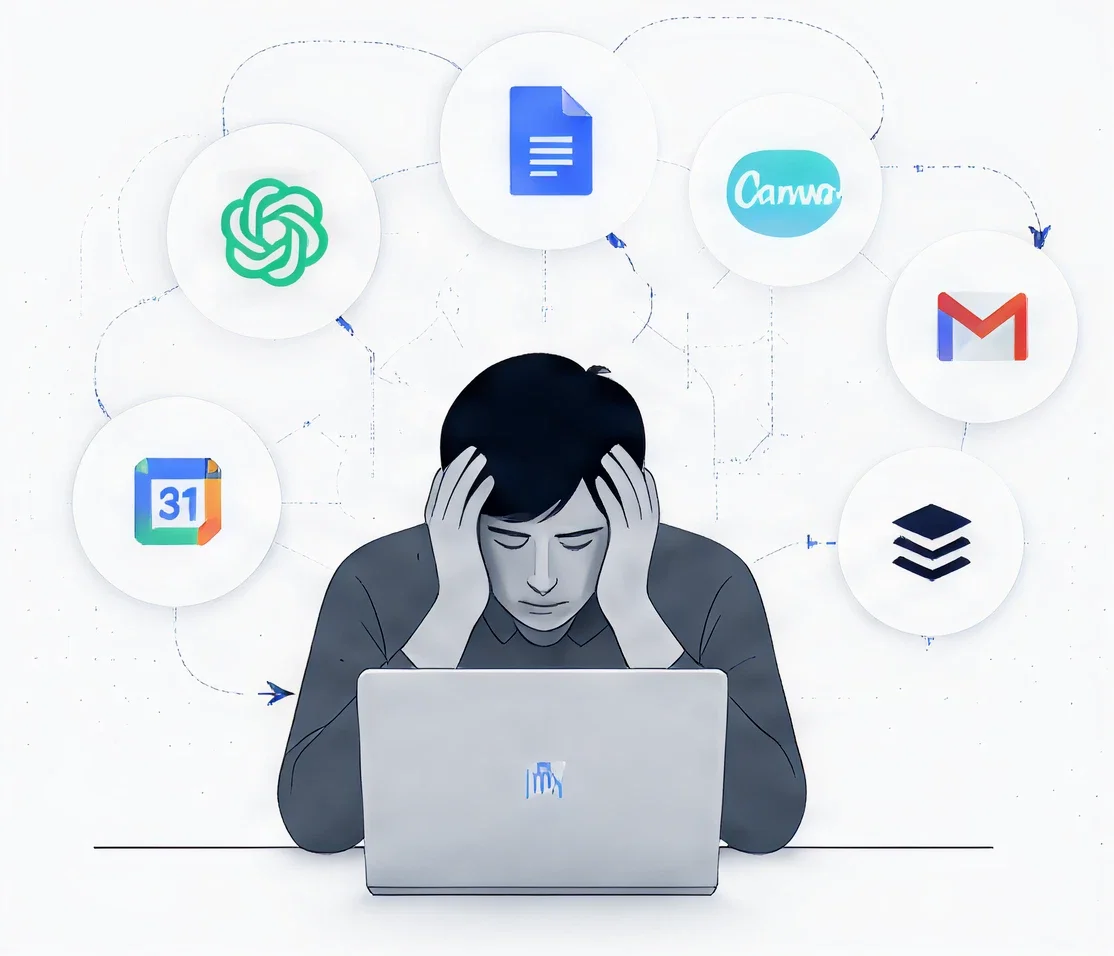
It's 10:47 pm on a Sunday. You have six LinkedIn posts due tomorrow morning for three different clients.
You open the AI tool. You paste the brief. You get something back in 12 seconds that is technically correct, professionally written, and sounds absolutely nothing like the founder it's supposed to represent.
You start editing. An hour passes. Then the message arrives — the one you were half-expecting. A client, replying to last week's post you spent an hour fixing: "Hey, this one feels a bit… off. Can we make it sound more like us?"
You close the laptop. The coffee is cold. You have five more posts to go.
This isn't a productivity story or a "wrong tool" story. It's what happens when agencies run AI content without an AI content workflow. Most agencies are stuck exactly here — between the promise of what AI was supposed to do and the reality of Sunday nights that haven't changed.
The gap isn't the technology. It's the system around it.
The numbers tell an uncomfortable story
If Sunday nights still feel the same as they did before AI, you're not alone. The data explains why — and it isn't a slow adoption curve. It's a systemic failure.
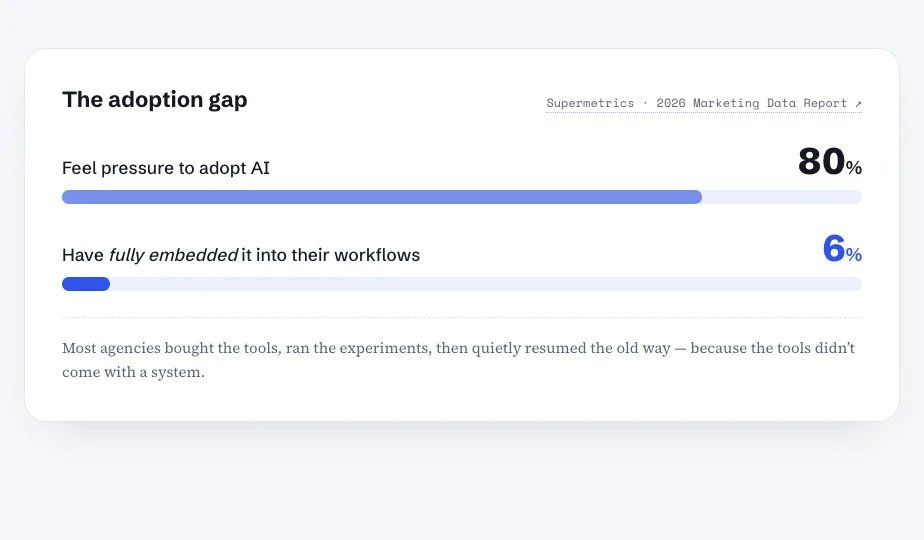
Supermetrics' 2026 Marketing Data Report found that 80% of marketing agencies feel pressure to adopt AI, but only 6% have fully embedded it into their actual workflows. Most agencies bought the tools, ran the experiments, then quietly resumed the old way — because the tools didn't come with a system.
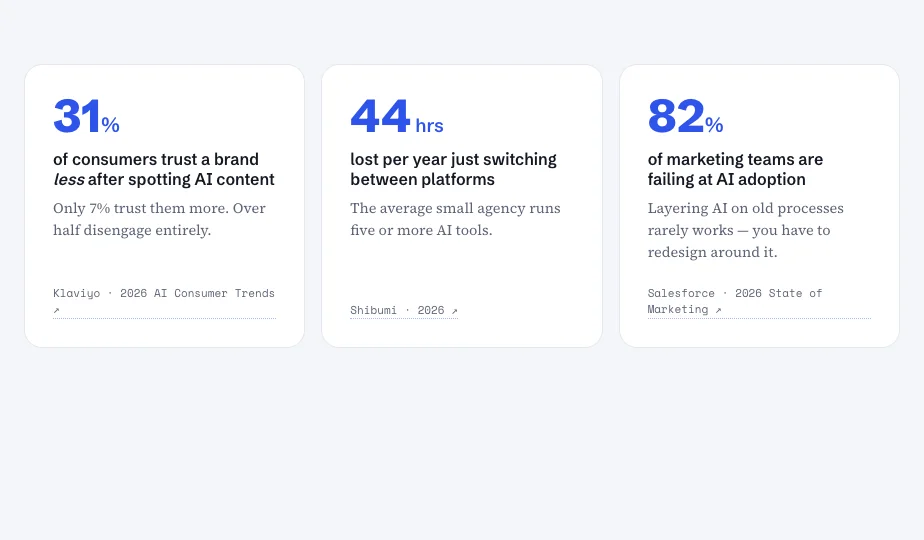
- 31% of consumers trust a brand less after spotting AI-generated content — only 7% trust them more, and over half disengage entirely (Klaviyo, 2026 AI Consumer Trends).
- The average small agency loses 44 hours per year just switching between five or more AI tools (Shibumi, 2026).
- 82% of marketing teams are failing at AI adoption (Salesforce, 2026 State of Marketing). McKinsey's research on agentic AI explains why: companies succeed when they redesign processes around AI, not when they layer AI onto existing ones.
Using AI and running a structured AI content workflow are two very different things. Most agencies are doing the first and calling it the second.
Why most AI content workflows break down
The failure pattern is almost always the same, and it breaks at four specific points. Fix one and you get incremental improvement. Fix all four and you have a workflow.
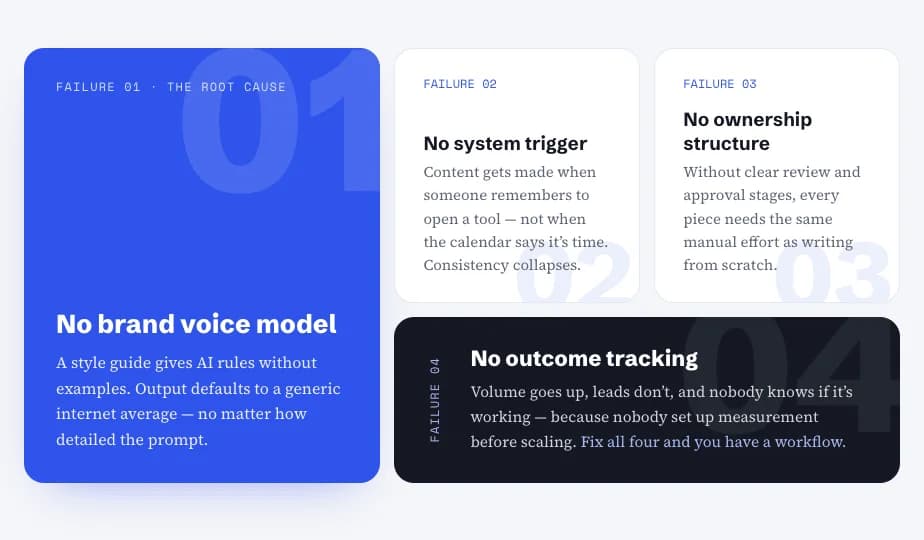
- No brand voice model. A style guide gives AI rules without examples. Output defaults to a generic internet average — no matter how detailed the prompt.
- No system trigger. Content gets made when someone remembers to open a tool, not when the calendar says it's time. Consistency collapses.
- No ownership structure. Without clear review and approval stages, every piece needs the same manual effort as writing from scratch.
- No outcome tracking. Volume goes up, leads don't, and nobody knows if it's working — because nobody set up measurement before scaling.
What a proper AI content workflow actually looks like (5 steps)
Most articles describe the concept and leave you to figure out the sequence. Here's the actual sequence: what happens in what order, and why each stage exists.
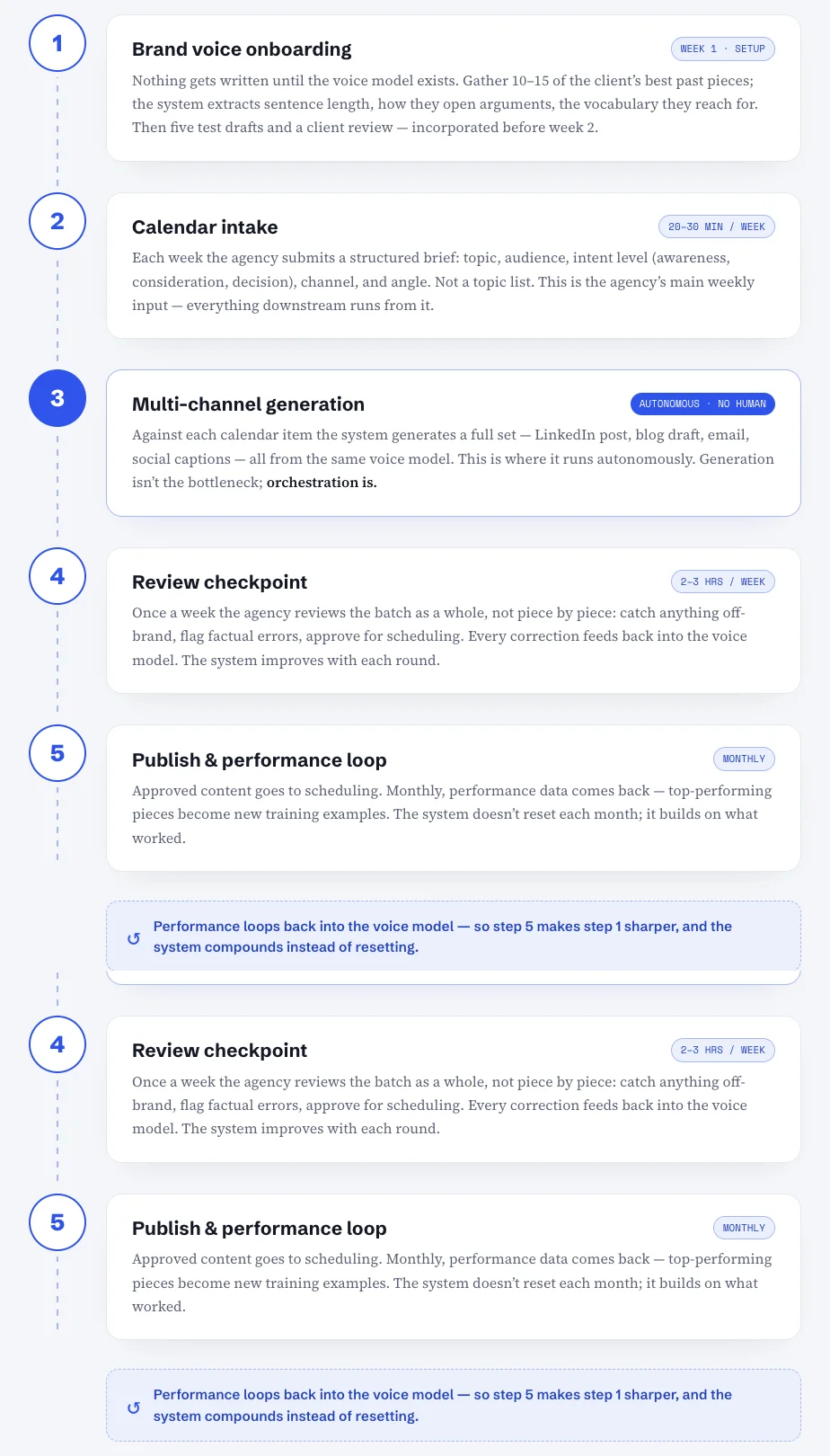
- Brand voice onboarding (Week 1 · setup). Nothing gets written until the voice model exists. Gather 10–15 of the client's best past pieces; the system extracts sentence length, how they open arguments, the vocabulary they reach for. Then five test drafts and a client review — incorporated before week 2.
- Calendar intake (20–30 min/week). Each week the agency submits a structured brief: topic, audience, intent level (awareness, consideration, decision), channel, and angle. Not a topic list. This is the agency's main weekly input — everything downstream runs from it.
- Multi-channel generation (autonomous, no human). Against each calendar item the system generates a full set — LinkedIn post, blog draft, email, social captions — all from the same voice model. Generation isn't the bottleneck; orchestration is.
- Review checkpoint (2–3 hrs/week). Once a week the agency reviews the batch as a whole, not piece by piece: catch anything off-brand, flag factual errors, approve for scheduling. Every correction feeds back into the voice model.
- Publish & performance loop (monthly). Approved content goes to scheduling. Monthly, performance data comes back — top-performing pieces become new training examples. The system doesn't reset each month; it builds on what worked.
Performance loops back into the voice model — so step 5 makes step 1 sharper, and the system compounds instead of resetting.
What this looks like in practice
Here's the same agency before and after — a 4-person GTM team managing content for 4 clients, six weeks apart.
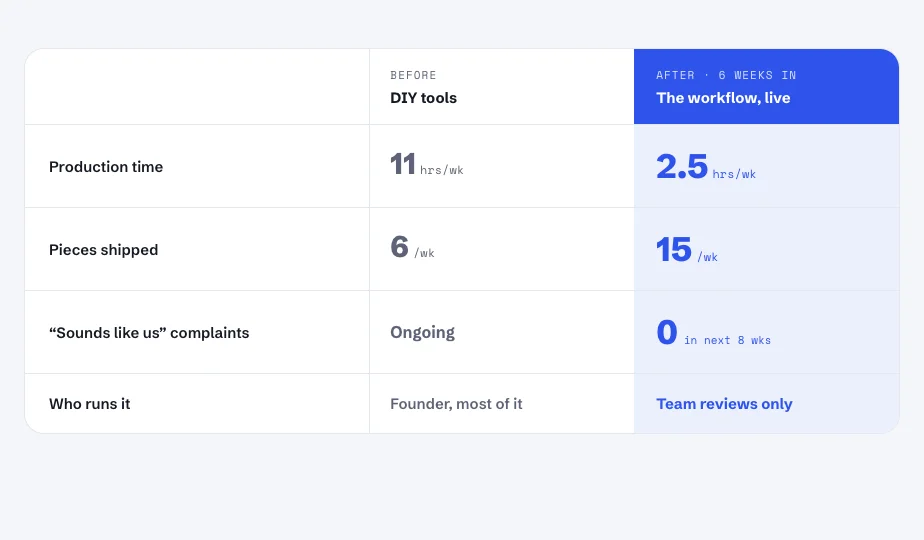
Before the system, content production ran 11 hours a week — prompting, editing, briefing, scheduling, fixing pushback, mostly on the founder. Six weeks after the AI content workflow went live, production time was 2.5 hours a week, output was 15 pieces a week across the same 4 clients, and in the following 8 weeks there were zero brand-voice complaints.
77% less production time. 2.5× the output. Zero complaints.
"I didn't open a content tool once this weekend." — that's the actual goal.
Representative onboarding results — not from a single named client.
The comparison most agencies don't make
Before choosing how to implement a workflow, it helps to see what you're actually choosing between.
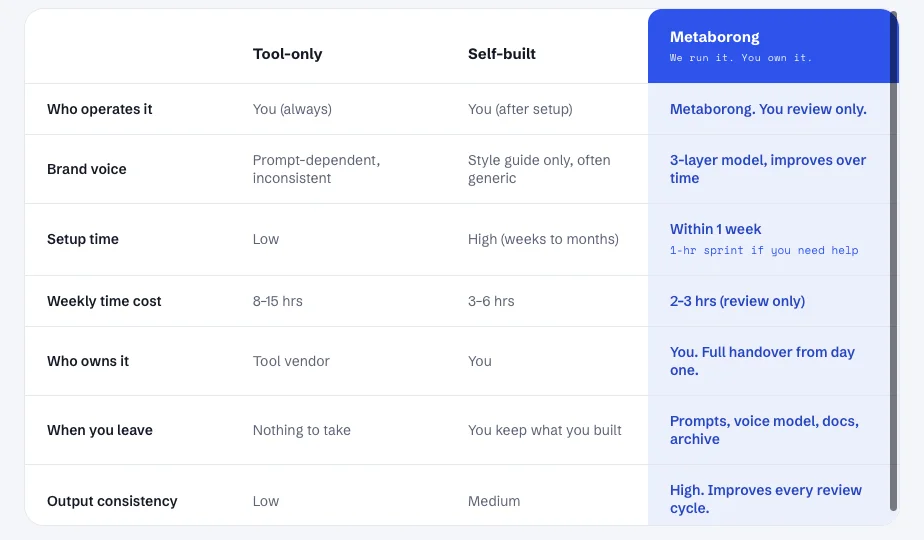
| | Tool-only | Self-built | Metaborong (We run it. You own it.) | |---|---|---|---| | Who operates it | You (always) | You (after setup) | Metaborong. You review only. | | Brand voice | Prompt-dependent, inconsistent | Style guide only, often generic | 3-layer model, improves over time | | Setup time | Low | High (weeks to months) | Within 1 week (1-hr sprint if you need help) | | Weekly time cost | 8–15 hrs | 3–6 hrs | 2–3 hrs (review only) | | Who owns it | Tool vendor | You | You. Full handover from day one. | | When you leave | Nothing to take | You keep what you built | Prompts, voice model, docs, archive | | Output consistency | Low | Medium | High. Improves every review cycle. |
The brand voice problem is harder than a style guide
A style guide describes what to avoid. It can't teach how a founder sounds when they're making a point they actually care about — the rhythm of their sentences, what they say bluntly versus diplomatically. OmniBound (2026) found that organizations using AI to produce better content see 2.4× better ROI than those producing more mediocre content at scale.
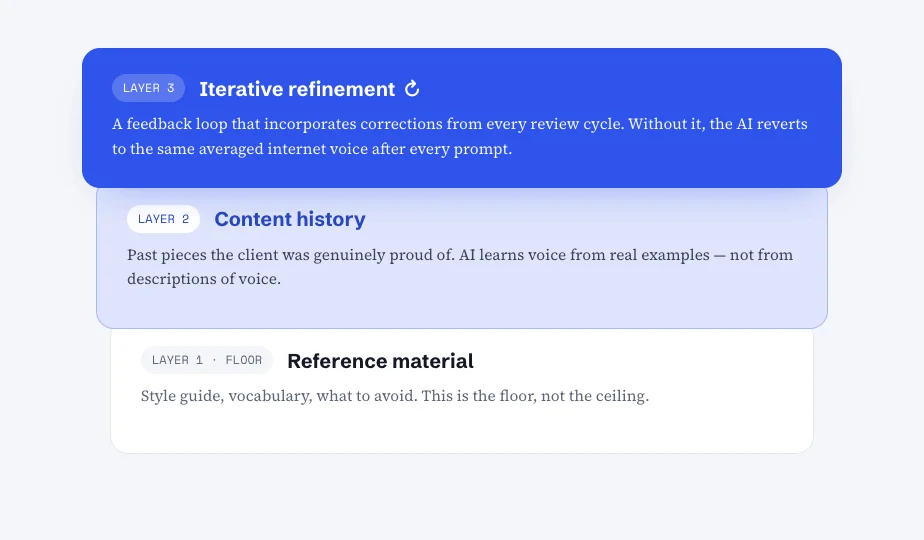
A real voice model has three layers:
- Reference material — style guide, vocabulary, what to avoid. The floor, not the ceiling.
- Content history — past pieces the client was genuinely proud of. AI learns voice from real examples, not descriptions of voice.
- Iterative refinement — a feedback loop that incorporates corrections from every review cycle. Without it, the AI reverts to the same averaged internet voice after every prompt.
Handing ChatGPT a detailed system prompt feels like it should work — and doesn't. The prompt is a rule. The voice model is a living system.
The ownership gap most services ignore
There are two ways to solve the AI content problem without solving it. The first is a tool: someone sells you access, gives you an onboarding call, and disappears — you're the operator, back to Sunday nights. The second is a done-for-you content shop: they handle everything, and when they leave, the voice model walks out with them.
A properly structured workflow works neither way. An external team operates the engine — but the prompts, the voice model, the workflow documentation and the content archive belong to the agency from day one.
Renting your content system is the same risk as outsourcing your client relationships. You get the output. You don't get the capability.
That's why "We run it. You own it." is a delivery model, not a tagline.
An honest diagnostic
Three questions cut through most of the noise about where your current AI content workflow is actually breaking down.
Q1 — A voice model, or just a style guide? If it's only a style guide, your AI has rules but no examples; the output reverts to generic no matter how you refine the prompt. Fix → Pull your client's 10–15 best past pieces and structure them as training material.
Q2 — Are you still the operator? If every piece requires you to open a tool, write a prompt, edit and manually schedule, you have an AI assistant, not an AI content workflow. Fix → The workflow needs redesigning, not the tool.
Q3 — Measuring output, or outcomes? If you can count posts published but not leads influenced or retention signals, the workflow is optimised for the wrong thing. Fix → Volume without measurement is just a faster way to make content nobody can prove is working.
Uncomfortable on all three? That's where 83% of marketing teams sit, somewhere between experimenting and a real system. The gap is closable. It just requires building something, not buying something.
Ready to see where your workflow is breaking down?
Metaborong runs your AI content workflow from day one — a brand voice model built on your clients' actual content, calendar execution across LinkedIn, blog, email and social, and a review checkpoint that costs your team 2–3 hours a week instead of 11. When it works, you own everything we built: the prompts, the voice model, the full workflow documentation, the content archive. No platform lock-in. No knowledge that walks out the door.
→ Get your free workflow audit at metaborong.com
Frequently asked questions
What is an AI content workflow for marketing agencies? A structured system where AI generates content across channels (LinkedIn, blog, email, social) against a pre-set calendar, with a brand voice engine keeping every output on each client's tone. Unlike using AI writing tools manually, it runs with a single human approval checkpoint rather than requiring the team to operate it step by step.
Why do these workflows fail so often? Four common failure points: no real brand voice model, no system trigger (content made reactively instead of on a calendar), no ownership structure for review and correction, and no outcome tracking. When any one is missing, the workflow defaults to more volume with inconsistent quality.
How is an agentic workflow different from just using AI writing tools? AI writing tools need a human operator at every step. An agentic workflow runs autonomously against a calendar, generates across all channels from a single voice model, and only needs human input at the review checkpoint. Typical weekly time cost: 8–12 hours for tool-only versus 2–3 hours for a properly built workflow.
How long does it take to build one that holds brand voice? Initial setup takes around a week. The first batch establishes the voice baseline; each review cycle tightens it. Most workflows pass the "sounds like us" check without heavy editing within four to six weeks of consistent use.
What channels does it typically cover? LinkedIn posts, long-form blog articles, email newsletters and social captions — all drawing from the same brand voice engine and running against the same calendar, so channel consistency improves over time rather than fragmenting as volume grows.
Asset index
All images referenced above live alongside this file:
- hero.png — hero illustration (operator overwhelmed by disconnected tools)
- stats-gap.png — the 80% / 6% adoption-gap bar chart
- stats-grid.png — the 31% / 44 hrs / 82% stat cards
- bento.png — the four failure points (bento layout)
- five-steps.png — the five-step workflow diagram with feedback loop
- case-before-after.png — before/after results comparison
- comparison.png — tool-only vs self-built vs Metaborong table
- voice-model.png — the three-layer brand voice model